
Homeowner guide
Mold in Austin homes: what Texas actually requires
A licensed trade we do not practice, explained by a contractor who has no reason to oversell it.
Start here
We do not do mold remediation
Texas licenses mold assessment and mold remediation through the Texas Department of Licensing and Regulation. We do not hold those licenses. We do not perform mold remediation, we do not quote it, and if you call us about visible mold we are going to tell you to hire someone licensed for it.
This page exists anyway, because homeowners dealing with water damage ask us about mold constantly — and most of what is written about mold online was written by companies that make money removing it. Here is what the rules actually say, from a contractor with nothing to sell you on this particular subject.
The rules
What Texas requires
Texas treats mold work as two separate licensed trades, deliberately kept apart.
Assessment and remediation are different licenses
A mold assessment consultant inspects, samples, and writes a remediation protocol — the document that says what has to be done. A mold remediation contractor carries out that protocol. Both are licensed by TDLR, and licenses are issued to individuals and to companies.
They are supposed to be independent
On the same project, the company assessing the problem and the company fixing it are generally required to be independent of one another. The logic is straightforward: the party telling you how bad it is should not be the party whose invoice grows with the answer.
This is the single most useful thing to know as a homeowner. If one company offers to inspect, diagnose, and remediate as a package, that arrangement is worth questioning.
The 25-square-foot rule is narrower than people think
Texas has a minimum area exemption: mold contamination affecting less than 25 contiguous square feet generally does not require a licensed remediator. It is why you can clean a patch of bathroom mildew yourself without hiring anyone.
What it does not mean: it is not a license to hire an unlicensed contractor for a larger job, and an unlicensed person cannot issue the certificate described below regardless of size. A licensed remediation contractor also does not get to skip the rules just because a job is small.
The certificate matters later
When licensed remediation is performed, the contractor issues a Certificate of Mold Damage Remediation. Keep it. It matters to your insurer, and Texas sellers generally have to disclose mold remediation history — the certificate is how you show the work was done properly rather than leaving a buyer to wonder.
Verify the license yourself
TDLR publishes a free public license search. Anyone quoting you mold work should give you a license number without hesitating, and it takes about thirty seconds to check it at tdlr.texas.gov/LicenseSearch.
The real timeline
Mold is a water problem first
Almost every mold problem we see started as a water problem nobody dried properly.
On wet drywall, framing, insulation, or cabinet material in an Austin summer, growth can begin within roughly 24 to 48 hours. The variable is not luck. It is whether the material actually got dry, all the way through, and whether anyone measured it rather than assuming.
Household fans move air around a room. They do not remove moisture from a wall cavity, from under a floating floor, or from the back side of a cabinet toe-kick. That is where the water you cannot see sits, and that is where growth starts.
Structural drying — extraction, air movers, dehumidification, and moisture readings taken until the numbers come back to normal — is water damage work, not mold work. It requires no mold license, because there is no mold yet. That is the entire point of doing it quickly.
Once mold is established and past that 25-square-foot threshold, you have moved into a different trade with a different license, and the honest answer is that you need someone else.
Vetting
What to ask before you hire anyone
- What is your TDLR license number? Then check it. A licensed company will expect the question.
- Who wrote the protocol? You want an independent assessor's written protocol before removal starts — not a scope written by the company doing the removal.
- What does the protocol actually say? Containment, negative air, what gets removed, what gets cleaned, where the boundary is. Ask to read it.
- Who does clearance testing, and when? Post-remediation verification should be done by the assessor, not the remediator.
- Will I get a Certificate of Mold Damage Remediation? The answer should be an immediate yes.
- What happens to the rebuild? Remediation ends with the affected material gone and the area cleared. Putting the room back — drywall, trim, flooring, paint — is separate construction work.
Be careful with a free mold inspection offered by a company that also wants the removal contract. It is not necessarily improper, but it is exactly the conflict the independence rule exists to prevent.
Where we fit
What we actually do
Two places, both outside mold licensing, and we would rather be clear about the boundary than vague about it.
Before: drying the water out
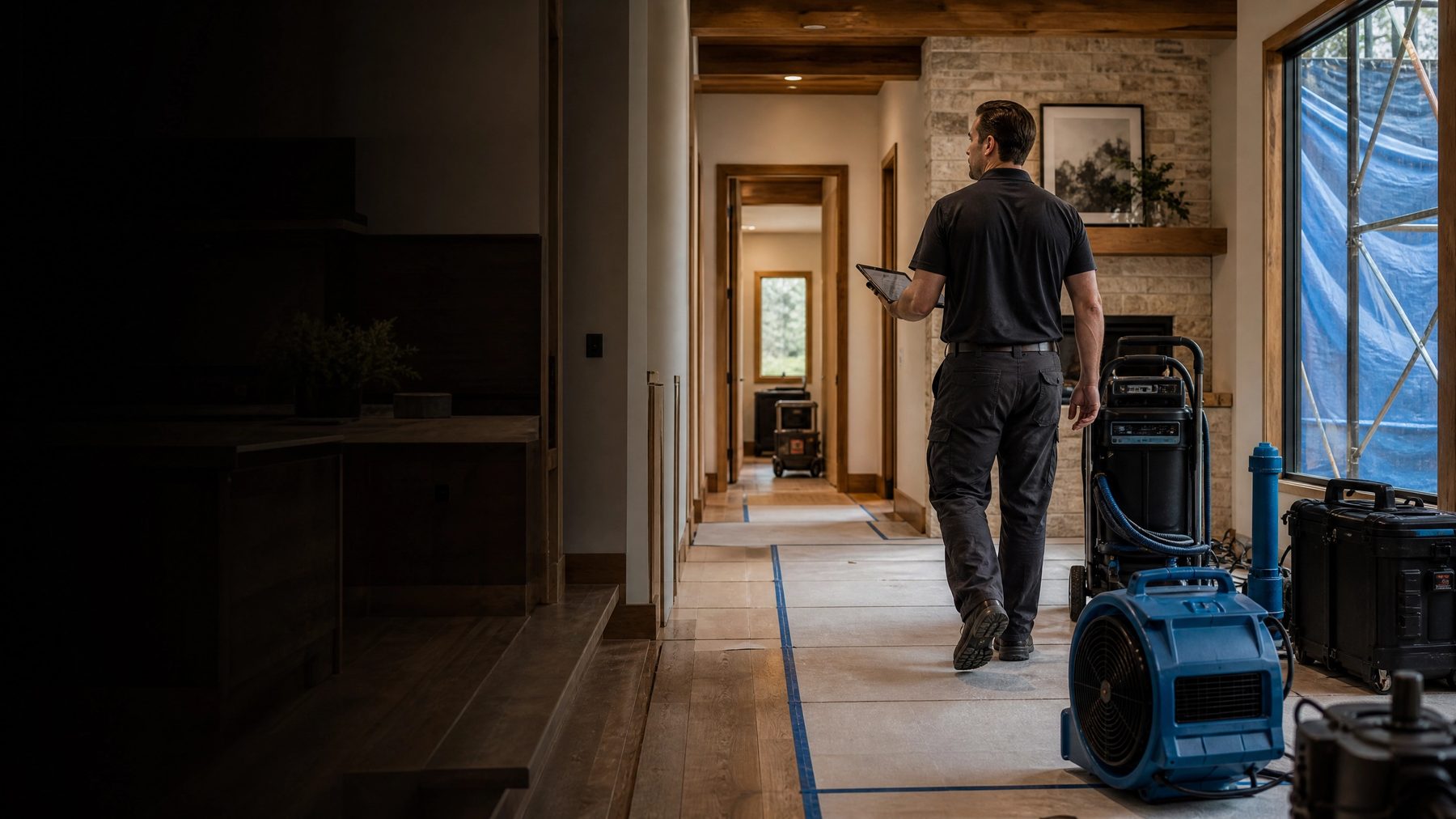
We are IICRC certified for water damage restoration. On a fresh loss we extract, set drying equipment, and document moisture readings until the structure is genuinely dry. Done promptly and measured properly, this is what keeps a water loss from becoming a mold question at all.
After: putting the room back
Once a licensed remediator has finished and the area has been cleared, the reconstruction is ordinary construction — and that is our work. Drywall, insulation, trim, cabinetry, flooring, paint, finish carpentry, matched to what was there before.
If you are somewhere in the middle of this and not sure which stage you are at, call and describe it. We will tell you honestly whether it is a drying job, a remediation job, or a rebuild — including when the answer means hiring someone other than us.
Call (512) 838-4236 — someone answers, day or night.
One more thing
A note on insurance
Mold coverage is one of the most commonly misunderstood parts of a homeowner's policy. Many Texas policies limit or exclude mold damage while still covering the sudden water event that caused it, and limits are often capped well below the cost of a large remediation.
What that means practically: documentation from day one matters more here than almost anywhere else in property claims. Photographs, moisture readings with dates, and a clear record of when the loss happened and when drying began are what separate a covered water claim from a disputed mold exclusion.
We are contractors, not adjusters or attorneys, and we cannot tell you what your policy covers. Read it, and ask your adjuster directly what the mold limit is before anyone starts work.